

Home
Instant-Read vs Leave-In Meat Thermometer: Which One Do You Need?
An instant-read thermometer checks food near the end of cooking; a leave-in thermometer stays in the food and follows the whole cook. Which one fits depends on what you cook most. The speeds, depths and safe temperatures below come from the U.S. Department of Agriculture.

TempPro promo code: thermoproteam, 10% off, recorded Nov. 1, 2026. We may earn a commission.
On this page

The essentials
Key takeaways
- Instant-read thermometers are not designed to stay in food while it cooks: they check the temperature near the end.
- Digital instant-read models read in 2 to 10 seconds; an instant-read dial takes 15 to 20 seconds and needs 2 to 2.5 inches of probe in the food.
- Leave-in thermometers come in three kinds: oven cord, wireless or smart, and oven-safe dial.
- The USDA's safe minimums: 145 °F with a 3-minute rest for whole cuts of beef, pork, veal and lamb, 160 °F for ground meats, 165 °F for all poultry.
Start from what you cook
The choice is made by the food, not by the gadget.
- Food that cooks in minutes, such as burgers, chops, chicken breasts and fish fillets: you check it once or twice near the end. That is an instant-read thermometer's job.
- Food that cooks for an hour or more, such as a roast or a whole bird: you want the temperature without opening the oven or lifting the lid every ten minutes. That is a leave-in thermometer's job.
- Both, on the same weekend: a kitchen that grills on Saturday and roasts on Sunday needs one of each, and some stores sell them as a pair.
What an instant-read thermometer is built for
A quick spot check. The Food Safety and Inspection Service of the U.S. Department of Agriculture (USDA) sorts food thermometers by how fast they read and how deep they must go. Its two digital instant-read types are the thermistor, which reads in about 10 seconds with the probe at least half an inch into the food, and the thermocouple, the fastest, at 2 to 5 seconds and a quarter of an inch. Both can measure thin and thick foods, and the USDA says of both that they are not designed to remain in food while it cooks: you use them near the end of the cooking time.
The older dial version behaves differently. An instant-read dial thermometer takes 15 to 20 seconds and needs 2 to 2.5 inches of probe in the food, because it averages the temperature along the stem. In a thin food it only works inserted sideways.
What a leave-in thermometer is built for
Watching a cook from start to finish. The USDA lists three kinds that can stay in the food. An oven cord thermometer has a probe in the food and a base unit that sits on the counter or the stovetop, and it is designed to remain in place in an oven or a covered pot. A wireless or smart thermometer is left in the food too, at least an inch deep in the thickest part, and gives a live reading; the USDA notes that it costs more. The oven-safe dial thermometer is the slow one: 1 to 2 minutes to settle, 2 to 2.5 inches deep, and not suited to thin foods.
Side by side
| Type | Time to read | How deep | Stays in while cooking |
|---|---|---|---|
| Thermocouple (digital instant-read) | 2 to 5 seconds | 1/4 inch or deeper | No |
| Thermistor (digital instant-read) | 10 seconds | At least 1/2 inch | No |
| Instant-read dial | 15 to 20 seconds | 2 to 2.5 inches | No |
| Oven cord (digital leave-in) | 10 seconds | At least 1/2 inch | Yes |
| Wireless or smart | Continuous | At least 1 inch, thickest part | Yes |
| Oven-safe dial | 1 to 2 minutes | 2 to 2.5 inches | Yes |
Figures from the USDA's table of food thermometers.
The numbers either one is there to hit
Whichever you buy, it exists to confirm a temperature. The USDA's chart of safe minimum internal temperatures gives:
- 145 °F, then a rest of at least 3 minutes, for steaks, chops and roasts of beef, pork, veal and lamb;
- 160 °F for ground meats;
- 165 °F for all poultry, whole or in pieces, and for stuffing;
- 145 °F for fish and shellfish;
- 165 °F for leftovers and casseroles.
The USDA's position is that a food thermometer is the only reliable way to know a food has reached its safe temperature.
Where to find each kind in one store
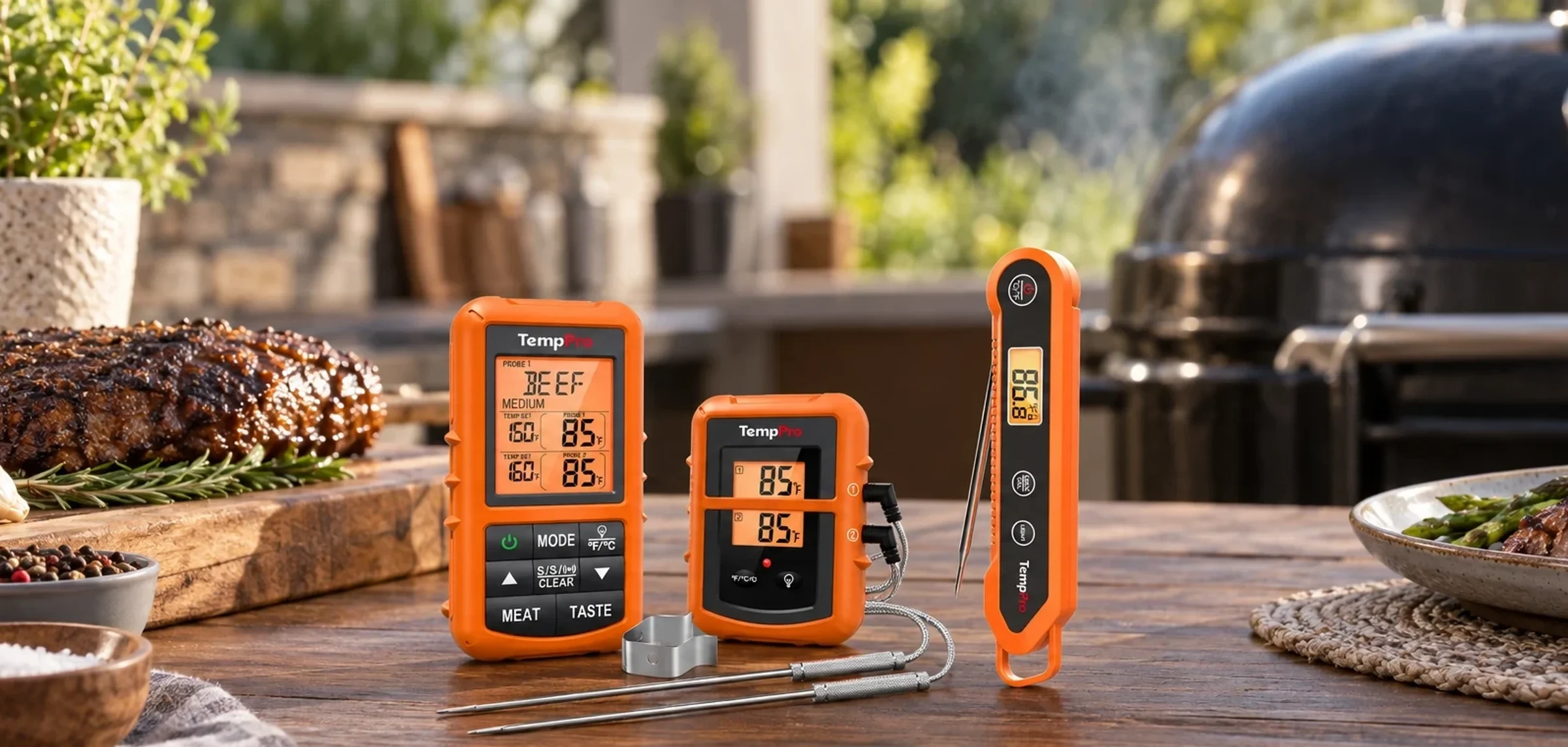
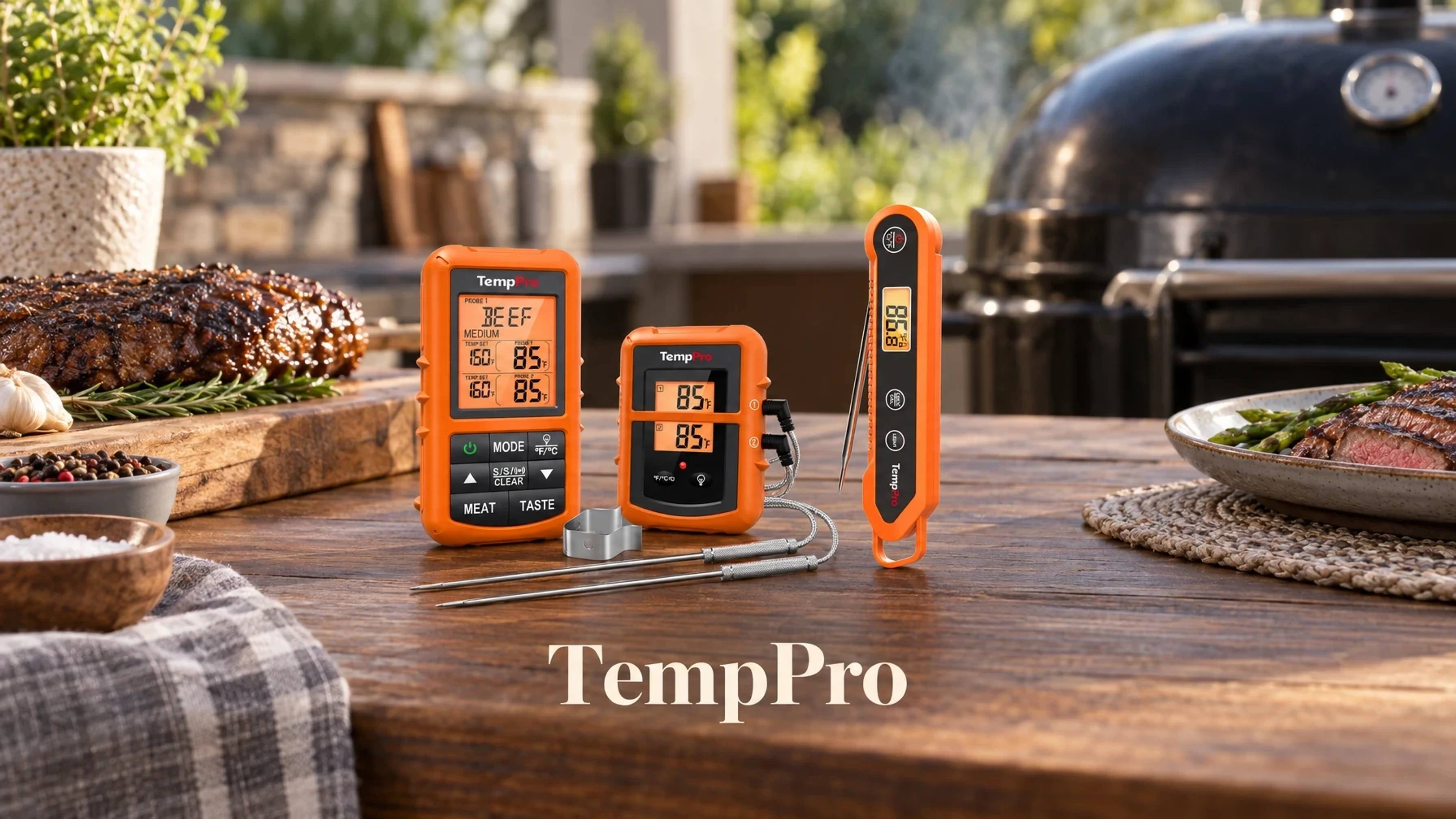
TempPro sells digital thermometers and sorts its shop along exactly this line, which makes it a convenient place to compare: one shelf for instant-read meat thermometers, one for leave-in models, and one for wireless probes, up to a four-probe model that connects over Wi-Fi and Bluetooth. It also sells bundles that pair a leave-in thermometer with an instant-read one, for the kitchens that need both.
Before you trust the reading
Two habits from the USDA apply to every type. Check the accuracy now and then: calibration can be tested in ice water, which the USDA calls the best method for most thermometers, or in boiling water. And look after the tool: wash it by hand with hot, soapy water or as the manufacturer says, since most thermometers should not be immersed.
The stores
Stores named in this article
- Coupon codeExclusive
TempPro
10%OFF
10% off at TempPro with code thermoproteam
Enter thermoproteam at checkout on TempPro. Discount as read on Oct. 30, 2026. Conditions: 10% off your order with code thermoproteam..
Terms and conditions
10% off your order with code thermoproteam.
Questions & answers
Questions people also ask
Can you leave an instant-read thermometer in the oven?
No, unless its maker says so. The USDA describes instant-read thermometers as not designed to remain in food while it is cooking, and warns that some models have plastic faces that can melt when placed too close to heat. A thermometer stays in the food only when its instructions state that it can withstand the heat and was designed for that purpose.
Do digital meat thermometers need to be calibrated?
It depends on the type. The USDA's table says an oven cord thermometer cannot be calibrated, a thermocouple can, and some thermistor models can, so the manufacturer's instructions decide. Any thermometer's accuracy can still be checked, in ice water for most models or in boiling water for higher temperatures.
Is the color of the meat enough to tell that it is done?
No. The USDA states that color and firmness are not reliable indicators that food is safe, and that a food thermometer is the only way to know. In a USDA study, 21% of participants relied on visual cues such as color and grill marks to decide whether their hamburger patties were fully cooked.
Our research
Sources
- Food ThermometersU.S. Department of Agriculture, Food Safety and Inspection Service · fsis.usda.gov · Retrieved
- Safe Minimum Internal Temperature ChartU.S. Department of Agriculture, Food Safety and Inspection Service · fsis.usda.gov · Retrieved
- TempPro: meat thermometers by typeTempPro · temppro.com · Retrieved
Every fact in this article comes from one of these references. Open them and check.